 Han River Cruise
Best Time for a Han River Cruise: A Month-by-Month Guide
Last reviewed 2026-08-21
When is the best time? Han River cruise conditions peak April through June and September through October, when Seoul's air is clearest, temperatures sit comfortably between 13°C and 23°C, and the Banpo Bridge Rainbow Fountain runs its full April-to-October season without the July monsoon interruptions. Winter, December through February, is a genuine runner-up for a different reason: heated cabins and the sharpest, haze-free skyline air of the year. The window to plan around rather than for is midsummer, when the fountain schedule shifts around monsoon weather and the Fireworks Music Cruise pauses in July. Even in the off months the riverside parks stay worth going, so no date here is a wasted one.
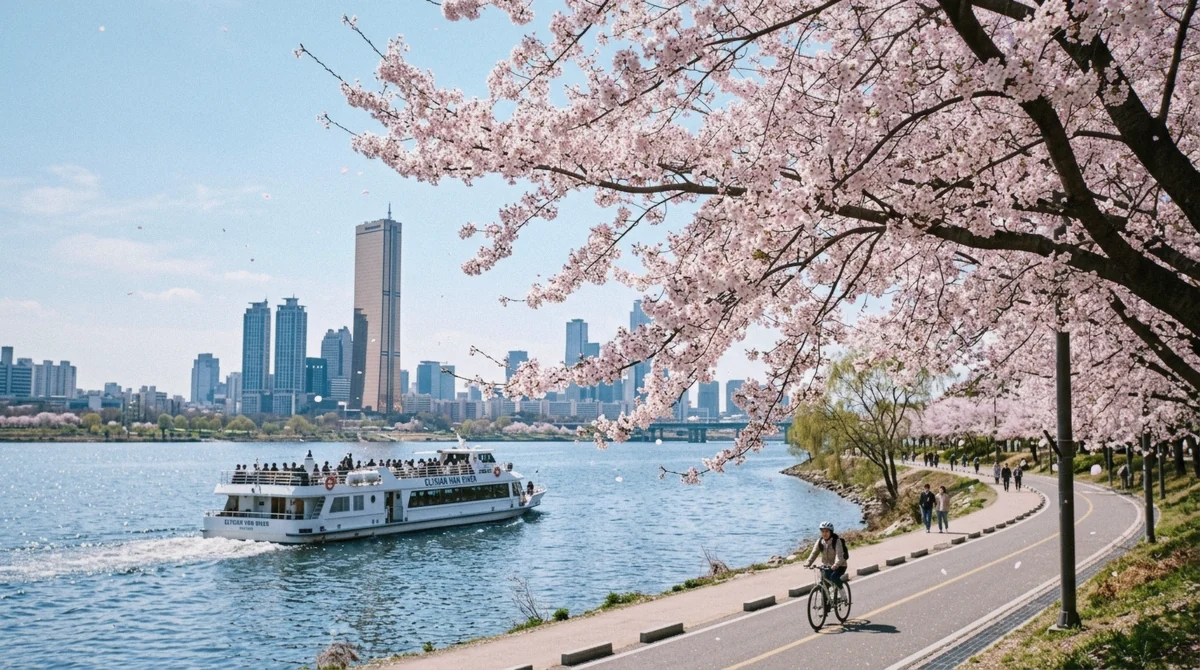
Quick answer The best months, the runner-up season, and the one window to plan around
April through June and September through October are the best time for a Han River cruise, thanks to clear air, comfortable temperatures and the Rainbow Fountain running its full schedule at Banpo Bridge. Winter is a solid runner-up for skyline clarity in heated cabins, and midsummer, especially July, is the window to plan carefully around rather than target directly.
Key takeaways
- Best window: April to June and September to October, 13°C to 23°C, clearest air of the year
- Runner-up: winter (December to February), heated cabins and the sharpest skyline air, though the fountain doesn't run
- Month to watch: July, when the Fireworks Music Cruise pauses and monsoon rain brings the highest cancellation odds
- Counterintuitive fact: humidity, not rain itself, is what fogs out a clear skyline shot; see what actually affects the view
- Best time of day: evening departures beat daytime year-round for the skyline and fountain views
- Price signal: the Tour and Starlight cruises carry a 35% summer 2026 campaign discount, see current Han River cruise prices if budget is the deciding factor
Seasons at a Glance
Read the Verdict column first for the short answer, then the two columns beside it before booking a specific month.
Month-by-month
Daytime highs are typical for Seoul, not a forecast for your travel dates.
| Month | Conditions | Weather | Verdict |
|---|---|---|---|
| January | Sunset Cruise runs 17:00; heated cabins | Cold, dry, clearest air | Good, sharp skyline, no fountain |
| February | Same winter schedule as January | Cold, dry | Good, sharp skyline, no fountain |
| March | Fountain season not yet open | Warming, occasional rain | Good value, cooler water |
| April | Fountain opens; Spring Flower Festival at Yeouido | Mild, roads jam near the festival | Best overall, take the subway |
| May | Fountain in full swing, Moonlight sunset trap begins | Warm, comfortable | Best overall |
| June | Fountain in full swing | Warm, humid building | Best overall |
| July | Fireworks Cruise paused, runs as Moonlight | Monsoon rain, cancellation risk highest | Avoid, monsoon peak |
| August | Fireworks Cruise resumes; extra 21:30 fountain show | Hot, humid | Fair, hazier skyline |
| September | Fountain still running | Clearing air, comfortable | Best overall |
| October | Fountain's last month; high tide Oct 7–9 reroutes Moonlight | Cool, clearest air of the year | Best overall |
| November | Fountain season ends; winter schedule begins | Cold, dry | Good, transitional |
| December | Winter schedule; heated cabins | Cold, dry, sharp air | Good, sharp skyline, no fountain |
Read against the table, the pattern is clear: the fountain season (April to October) and the clean-air months overlap heavily in spring and again in autumn, which is why those two windows carry the strongest verdicts, while July stands alone as the month with the highest cancellation odds.
Temperatures and rainfall
Figures are typical monthly averages for Seoul; check the current forecast close to your dates.
| Month | High (°C / °F) | Rain |
|---|---|---|
| January | −2°C / 28°F | Low |
| February | 1°C / 34°F | Low |
| March | 6°C / 43°F | Low to moderate |
| April | 13°C / 55°F | Moderate |
| May | 18°C / 64°F | Moderate |
| June | 23°C / 73°F | Moderate, rising |
| July | 26°C / 79°F | High, monsoon |
| August | 26°C / 79°F | High |
| September | 22°C / 72°F | Moderate |
| October | 15°C / 59°F | Low |
| November | 7°C / 45°F | Low |
| December | 0°C / 32°F | Low |
By the numbers, July and August tie as the warmest months at 26°C (79°F), while January is coldest at −2°C (28°F); July also carries the year's heaviest rain. Figures follow Korea Meteorological Administration normals for Seoul; check the current forecast close to your travel dates rather than relying on a monthly average.
Best Season by Traveler Type
If You want the clearest skyline photos
September or October, when air is driest and haze is lowest after the monsoon clears
If Traveling with kids and want calm, comfortable conditions
May, warm without midsummer humidity, and the fountain is already running
If First-time visitor who wants the safest bet against cancellation
September or October, since July's monsoon carries the highest weather-cancellation odds of the year
If You specifically want the Rainbow Fountain and don't mind heat
June through August, when the fountain runs its full daily schedule, including the extra 21:30 show in July and August
If Budget traveler chasing the lowest price
Late winter (February to early March), before spring demand builds, with the 2026 summer campaign as a second discount window
Spring (March to May): Clearest Skies, Festival Season
Temperatures climb from a cool 6°C in March to a comfortable 18°C by May, and the Rainbow Fountain reopens for the year in April, so the Moonlight and Fireworks routes start passing a working fountain again after the winter off-season. April adds the Yeouido Spring Flower Festival right along the cruise's own departure point; the cherry blossoms are a genuine draw, but roads around Yeouido jam hard during the festival, so arrive by subway to Yeouinaru Station rather than driving. Prices hold steady through spring with no seasonal discount, and booking a few days ahead is enough since demand builds gradually rather than spiking.
The trade-off: late April and May crowds thicken as the festival and comfortable weather line up, so evening slots can sell out closer to the date. Departures like the E-Land Moonlight Music Cruise run daily through the season.
Summer (June to August): Fountain in Full Swing, Monsoon Risk
June opens warm and comfortable at 23°C before July and August both push to 26°C with real humidity. July is the month to watch: monsoon rain drives the year's highest cancellation odds, and the Fireworks Music Cruise pauses for the month, running instead as a standard Moonlight sailing; it resumes as Fireworks in August. August compensates with an extra 21:30 fountain show added to the regular 19:30, 20:00, 20:30 and 21:00 lineup, on top of the 12:00 daytime show.
Prices are unchanged by season on the E-Land tickets, though the 2026 summer campaign's 35% discount on the Tour and Starlight cruises makes this a genuinely cheaper window for the daytime options specifically. Book a few days ahead in June and August; in July, build in flexibility given the cancellation risk. The Sevit Island yacht runs through summer as well, with blankets provided for cooler evening water.
Autumn (September to October): Best Overall, Clearest Air
September cools to 22°C and October to a crisp 15°C, and both months carry the year's clearest air after summer's humidity breaks, which is the single best combination this route offers for a skyline photo. The Rainbow Fountain runs through October, its last month of the year, giving a genuine window to catch both the clean air and the fountain together. One local quirk: October 7 through 9, 2026, a high-tide event reroutes the 20:30 Moonlight Cruise downstream, skipping Banpo Bridge for those specific dates, worth checking if a precise date matters.
Prices carry no seasonal discount here, and booking a few days ahead is enough outside that high-tide window. This is the season the site's own research points to first when someone asks for one best window.
Winter (November to February): Sharpest Air, No Fountain
The schedule itself changes in winter: the Sunset Cruise moves to 17:00 (from 18:00 the rest of the year), Moonlight to 19:30 (from 19:00/20:30), and Starlight to 21:00 (from 22:00), all shifted earlier to match shorter daylight. Temperatures drop to 7°C in November and as low as −2°C in January, but cabins are heated, and cold, dry winter air often produces the sharpest, least hazy skyline of the year, a real trade against the loss of the Rainbow Fountain, which is closed November through March. November also marks the start of the season for a winter-friendly guided evening that pairs the cruise with a warm sit-down meal.
Prices don't drop for winter specifically, but demand is lower, so last-minute booking is more realistic than in peak spring or autumn weeks.
What Actually Affects Conditions
Most people assume rain is what ruins a Han River cruise. It's actually humidity and haze, not rain itself, that decides whether the skyline photo comes out clear: a dry, cold January day delivers sharper long-distance visibility than a humid, cloudless August afternoon, because moisture in the air scatters light across the whole skyline rather than any single storm cell blocking the view. That's also why July, the wettest month, and August, nearly as warm but drier in comparison, feel so different on the water despite similar temperatures.
The Rainbow Fountain runs on its own separate logic: it's shut down for weather or river conditions at Seoul City's discretion, without advance notice, which is a decision about water safety and flow rather than visibility.
Best Time of Day
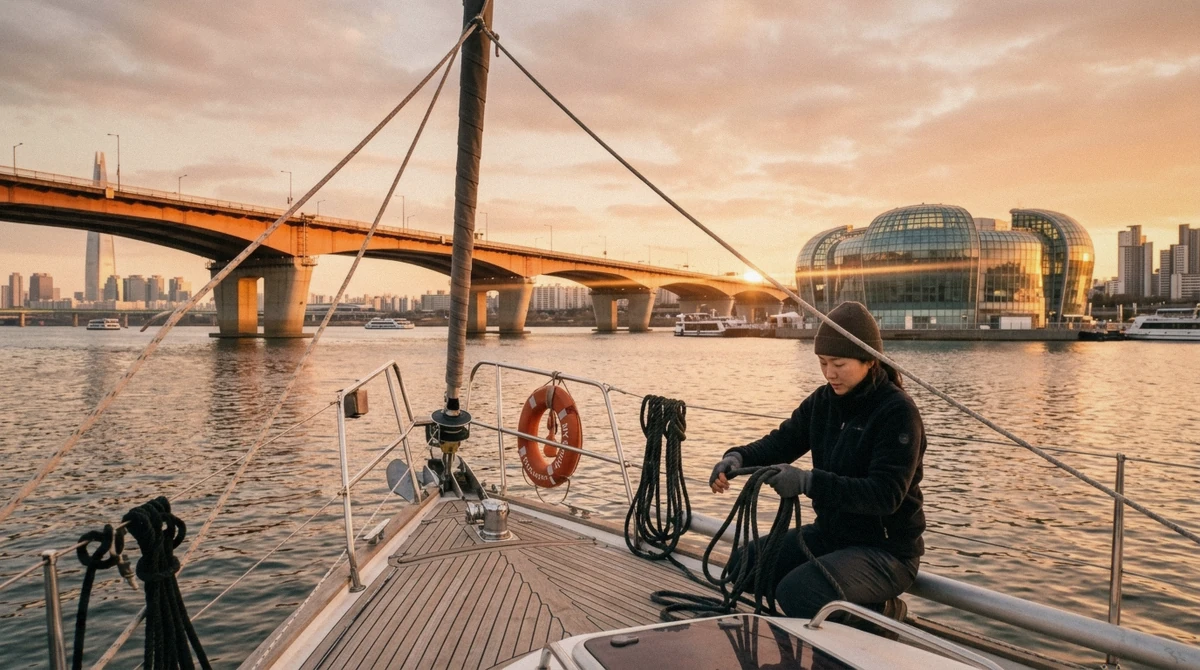
Evening beats daytime year-round for this activity, and the reasoning holds across every season: the skyline lit up after dark and, from April through October, the Rainbow Fountain, are simply not visible on a daytime sailing. Within "evening," the honest catch is the 18:00 Sunset Cruise between May and September, when Seoul's actual sunset lands closer to 19:30 and the boat is already back at the pier before the sky turns; the operator itself points travelers to the 19:00 Moonlight Cruise for a real summer sunset. From March through April and again in October, the 18:00 slot does catch golden hour, so it's a genuinely good choice in those specific months.
The one exception where daytime makes sense: the Tour Cruise, which is a daytime-only ticket built for sightseeing rather than skyline views, and it's the cheapest way to try the river regardless of season.
Crowds and Prices Through the Year
Two specific traps are worth naming rather than a vague "it gets busy." The Yeouido Spring Flower Festival in April brings genuinely jammed roads around the pier for roughly a week to ten days each spring; arriving by subway to Yeouinaru Station avoids the worst of it entirely. New Year's week in late December and early January is the other named crowd spike, when the cold-weather skyline draw combines with holiday travel to fill evening slots faster than usual. On price, the clearest signal is the 2026 summer campaign's 35% discount on the Tour and Starlight cruises; outside that window, E-Land's five ticket prices don't otherwise shift with season, so the crowd calendar matters more than the price calendar for planning around.
See current Han River cruise prices for the full fare table if a specific number is driving the decision.
What If the Weather Turns?
Light rain rarely cancels an E-Land sailing outright; real cancellation triggers are stronger river conditions, storms or the operator's own safety call, most common in July. tickets refund in full until two days before your date a normal booking gives real flexibility if a forecast turns bad in the days beforehand. If the trip has only one evening available, booking during a lower-risk month, spring or autumn rather than July, is the simplest hedge. For the fuller mechanics of how weather cancellations and refunds actually play out here, see what happens if your Han River cruise gets cancelled for weather.
So: April through June or September through October for the best overall combination of clear air, comfortable temperatures and a fully running fountain, with September and October the single strongest pick for photography. Winter is the honest budget-conscious runner-up if the fountain isn't the priority and a sharp skyline in the cold is. The one month to actively plan around is July, when monsoon rain and the Fireworks Cruise's pause make it the least predictable stretch of the year.
Whichever window fits your dates, which Han River cruise to book lays out all seven options with current schedules side by side, and how each Han River cruise fits the season has the same detail from the schedule angle if a specific date is already fixed.
Timing Questions for the Han River Cruise
What's the single best month for a Han River cruise?
October. It combines the year's clearest air with the Rainbow Fountain still running through its final month of the season, the strongest overlap of good conditions and the fountain window.
Is a Han River cruise still good in winter?
Yes, for a different reason than the rest of the year: cold, dry air produces some of the sharpest skyline visibility of the year, and cabins are heated. The trade-off is honest: the Rainbow Fountain is closed November through March.
When does the Rainbow Fountain season run?
April through October only. Shows run at 19:30, 20:00, 20:30 and 21:00 nightly, plus a 12:00 daytime show, with an extra 21:30 show added in July and August, each lasting 20 minutes.
Should I avoid booking in July?
It's the month with the highest weather-cancellation risk, thanks to monsoon rain, and the Fireworks Music Cruise pauses for the month. It's not a hard no, especially for photographers chasing dramatic sky, but plan flexibility into the date.
Morning or evening: which is better?
Evening, in every season. The lit skyline and, from April through October, the Rainbow Fountain, are only visible after dark; the one daytime-only option, the Tour Cruise, is priced and built for a different, cheaper kind of trip.
Does the cruise schedule change in winter?
Yes. Sunset moves to 17:00, Moonlight to 19:30 and Starlight to 21:00 from November through March, all shifted earlier than the rest-of-year times to match shorter daylight hours.
How many days ahead should I book for the best conditions?
A few days ahead covers most of the year. Around the April Spring Flower Festival and New Year's week, book further out, since evening slots fill faster during those two named crowd spikes.